
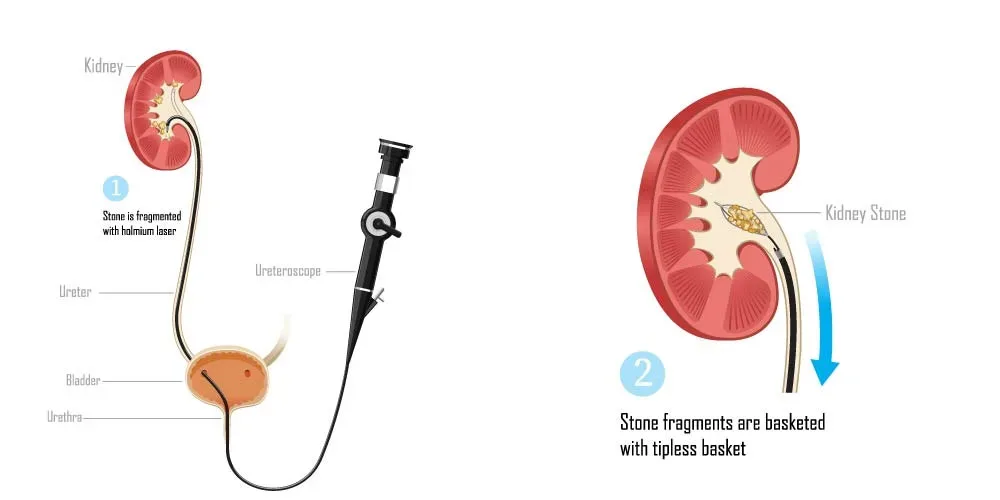
Retrograde Intrarenal Surgery (RIRS) is a minimally invasive endoscopic procedure used to treat selected kidney stones. A flexible ureteroscope is passed through the natural urinary passage into the kidney, where laser energy can be used to break stones into smaller fragments.
RIRS is one of several options for kidney stone treatment . Its suitability depends on the stone’s size, location, number, urinary anatomy, infection status and the patient’s overall health.
Dr. Prakash Sankapal, a urologist in Navi Mumbai , provides urology consultations at NewEra Hospitals, Vashi, and JP Kidney Care, Ulwe. Clinical assessment helps determine whether RIRS or another treatment approach is appropriate.
What Is RIRS?
RIRS stands for Retrograde Intrarenal Surgery. It is a type of flexible ureteroscopy in which the urologist accesses the kidney through the urethra, bladder and ureter.
The flexible ureteroscope contains a camera that allows direct visualisation of the urinary tract. During laser kidney stone treatment, laser energy is used to fragment suitable stones. Some fragments may be removed during the procedure, while others may pass afterwards.
RIRS generally does not require an external skin incision. However, it remains a surgical procedure with possible risks, limitations and complications.
When Is RIRS Considered for Kidney Stones?
RIRS may be considered when a kidney stone requires active treatment and flexible endoscopic access is clinically suitable.
Important factors include:
- Stone size: Smaller and medium-sized stones may be suitable. Larger stones may require staged procedures or another treatment approach.
- Stone location: Stones in different regions of the kidney may vary in accessibility.
- Persistent symptoms: Recurrent pain or blood in the urine may influence management decisions.
- Urinary obstruction: Stones interfering with urine drainage may require intervention.
- Infection status: Urinary infection must be identified and appropriately managed before elective stone removal.
- Previous treatment: RIRS may be considered when another treatment has not been suitable or has not achieved the intended outcome.
- Overall health: Kidney function, other medical conditions and anaesthesia suitability affect treatment decisions.
Important: Not every kidney stone requires surgery. Selected stones may be monitored or managed through other appropriate methods.
Learn more about the symptoms, diagnosis and treatment of kidney and ureteric stones .
How Is a Patient Evaluated Before RIRS?
Preoperative assessment helps the treating team understand stone characteristics, identify infection and plan the procedure.
Depending on clinical findings, evaluation may include:
- Medical history and review of urinary symptoms.
- Review of previous kidney stone treatments.
- Urine examination and urine culture.
- Blood investigations, including kidney function when indicated.
- Ultrasound or CT imaging to assess stone size, location and anatomy.
- Review of existing medicines, including anticoagulants.
- Assessment for anaesthesia and procedural risks.
A patient with suspected urinary tract infection may require additional evaluation. Active infection should be managed appropriately before planned stone surgery.
How Is RIRS Surgery Performed?
RIRS is carried out in an appropriately equipped surgical facility. The exact steps may vary according to the clinical findings and equipment used.
Step 1: Preoperative Preparation
The treating team reviews imaging reports, laboratory investigations, medical history and the planned surgical approach. Relevant infections are managed before elective treatment.
Step 2: Anaesthesia
RIRS is commonly performed under general anaesthesia. Other anaesthesia options may be considered in selected circumstances.
Step 3: Accessing the Kidney
A flexible ureteroscope is introduced through the urethra into the bladder and advanced through the ureter towards the kidney.
This approach usually avoids an external incision.
Step 4: Laser Stone Fragmentation
After identifying the stone, laser energy may be used to break it into smaller fragments.
Depending on the stone, fragments may be removed using specialised instruments or left to pass through the urinary tract.
Step 5: DJ Stent, If Required
A temporary ureteral stent, also known as a Double-J or DJ stent, may be placed to support urine drainage.
A stent is not routinely required after an uncomplicated procedure. Its use depends on procedural findings and individual clinical considerations.
Step 6: Recovery Monitoring
After surgery, the patient is monitored for recovery from anaesthesia, urinary drainage, discomfort, bleeding and possible complications.
Hospital discharge and follow-up plans depend on the patient’s condition.
What Are the Possible Benefits of RIRS?
RIRS has certain procedural characteristics that may be useful for selected patients.
- Access through the natural urinary passage.
- Generally no external skin incision.
- Direct visualisation of suitable kidney stones.
- Use of laser energy for stone fragmentation.
- Potentially shorter hospital stay than some more invasive procedures in selected circumstances.
- An option for selected patients when alternative procedures are unsuitable.
These potential benefits do not guarantee complete stone clearance, a particular recovery period or freedom from complications.
What Are the Risks and Possible Complications of RIRS?
Although RIRS is minimally invasive, complications can occur.
Possible risks include:
- Blood in the urine.
- Pain or burning during urination.
- Urinary tract infection.
- Fever or severe infection, including urosepsis.
- Injury to the ureter or other urinary tract structures.
- Discomfort related to a DJ stent.
- Residual stone fragments.
- Ureteric narrowing or scarring.
- Need for a second or staged procedure.
- Anaesthesia-related complications.
The individual risk depends on stone characteristics, infection status, kidney function, existing conditions and procedural findings.
Recovery After RIRS Surgery
Recovery after RIRS varies according to stone complexity, the procedure performed, general health and whether a ureteral stent was inserted.
Some patients return home after a short period of observation, while others may require a longer hospital stay.
Temporary symptoms can include:
- Mild blood in the urine.
- Burning or discomfort during urination.
- Urinary frequency or urgency.
- Flank or bladder discomfort related to a ureteral stent.
- Passage of small stone fragments.
Patients should follow the treating team’s instructions regarding:
- Prescribed medicines.
- Individual fluid intake advice.
- Physical activity and return to work.
- Follow-up imaging or urine tests.
- DJ stent removal, if applicable.
- Assessment of residual stone fragments.
Seek urgent medical attention: Fever, chills, severe or worsening pain, inability to pass urine, heavy bleeding or other concerning symptoms after surgery require prompt medical assessment.
RIRS vs PCNL vs Shock Wave Lithotripsy
Different kidney stone treatments are selected based on clinical findings. No single procedure is appropriate for everyone.
| Treatment | General Description |
|---|---|
| RIRS | Flexible endoscopic procedure performed through the urinary passage, commonly using laser fragmentation. |
| PCNL | Percutaneous nephrolithotomy accesses the kidney through a small opening in the back. Often preferred for larger or complex stone burdens. |
| Shock Wave Lithotripsy (SWL) | Uses externally generated shock waves to break suitable stones into fragments. |
| Observation | May be appropriate for selected stones that do not currently need active intervention. |
For kidney stones larger than 2 cm, PCNL is generally recommended as the first-line treatment in suitable patients. RIRS may be considered in selected cases, including when PCNL is not an option. Larger stones treated by RIRS may require additional procedures.
Clinical reference: European Association of Urology Guidelines on Urolithiasis .
Can Kidney Stones Return After RIRS?
Yes. RIRS treats existing stones but does not eliminate the possibility of future stone formation.
The risk of recurrence depends on factors such as stone composition, urinary chemistry, diet, hydration, metabolic conditions and medical history.
Follow-up may include:
- Stone composition analysis.
- Follow-up imaging.
- Blood and urine investigations.
- Metabolic evaluation for selected patients.
- Personalised dietary recommendations.
- Medical prevention where appropriate.
Learn more about kidney stone treatment and follow-up from NIDDK .
RIRS Consultation in Vashi and Ulwe, Navi Mumbai
Dr. Prakash Sankapal provides urology consultations for kidney stone conditions at the following locations.
NewEra Hospitals – Vashi
Sector 7,Sion–Panvel Highway,
Vashi, Navi Mumbai,
Maharashtra 400703.
Contact: +91 8007542142
JP Kidney Care – Ulwe
Plot No. 70,Moreshwar Heritage,
Sector 5, Ulwe,
Navi Mumbai,
Maharashtra 410206.
Contact: +91 8591009591
Consultation may involve reviewing ultrasound or CT reports, kidney stone size, location, urinary symptoms, kidney function and treatment options.
These are consultation locations. The facility at which any surgical procedure is performed should be confirmed separately.
Visit the urology consultation and clinic contact page for current details.
Frequently Asked Questions About RIRS
1. What is RIRS treatment for kidney stones?
RIRS is a minimally invasive endoscopic procedure used for selected kidney stones. A flexible instrument reaches the kidney through the urinary passage, and laser energy may be used to fragment stones.
2. Is RIRS a major surgery?
RIRS usually does not require an external incision, but it remains a surgical procedure performed under anaesthesia. Its complexity depends on individual factors.
3. Is RIRS surgery painful?
Anaesthesia is used during RIRS. Afterwards, urinary discomfort, mild bleeding or pain may occur, particularly when a ureteral stent is present.
4. Is RIRS suitable for a 20 mm kidney stone?
RIRS may be considered for selected stones measuring around 20 mm. Suitability depends on stone complexity, location, kidney anatomy and other clinical factors. PCNL may be more appropriate in certain circumstances.
5. How long does recovery take after RIRS?
Recovery varies. Some patients return to light activities within a few days, while others require more time depending on the procedure, complications or stent-related symptoms.
6. Is a DJ stent necessary after RIRS?
Not always. A DJ stent may be required when additional drainage or healing support is indicated. Routine stenting is generally not recommended after uncomplicated ureteroscopy.
7. Can kidney stones recur after RIRS?
Yes. RIRS removes or fragments existing stones, but future stone formation remains possible. Prevention depends on individual risk factors and stone type.
8. What is the difference between RIRS and PCNL?
RIRS accesses the kidney through the natural urinary passage. PCNL accesses the kidney through a small opening in the back and is often preferred for larger stones.
9. Can all kidney stones be treated with RIRS?
No. Depending on stone characteristics, management may involve observation, shock wave lithotripsy, RIRS, PCNL or another approach.
10. Where can I get information about RIRS in Navi Mumbai?
Dr. Prakash Sankapal provides urology consultations at NewEra Hospitals, Vashi, and JP Kidney Care, Ulwe. See the clinic contact page for current consultation details.
Medical References
Additional educational information is available through these sources:
Medical Disclaimer: Website content and visuals are for general informational, educational and representational purposes only, may not reflect individual patient conditions or outcomes, and do not replace personalised medical advice, diagnosis or clinical assessment.