
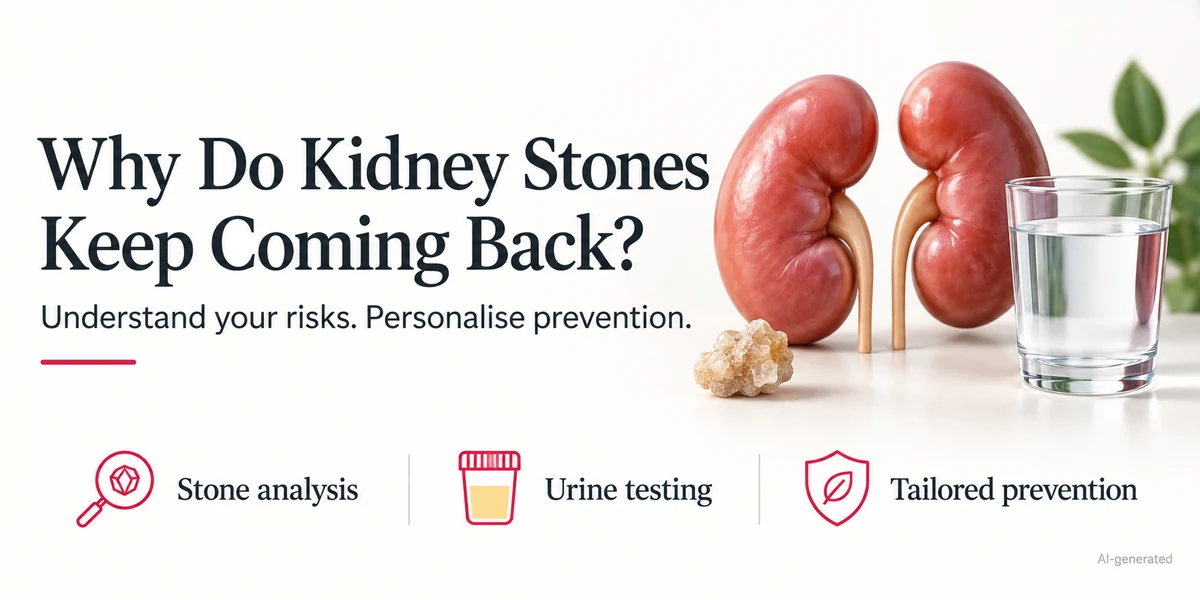
Kidney stones can return when the conditions that encouraged the first stone remain present. Concentrated urine, changes in urine chemistry, certain infections and underlying medical conditions can contribute.
Removing a stone treats the existing stone, but it does not necessarily remove the tendency to form another. For recurrent stones, assessment should consider both treatment and prevention. Stone analysis and appropriate metabolic testing can help guide an individual plan.
Recurrent kidney stones are further stones that develop after a previous episode. Another stone may appear months or years later.
However, a stone seen after treatment is not always newly formed. Residual fragments can remain and subsequently grow. Follow-up imaging helps assess remaining stones and changes over time.
Information about assessment and treatment is available on the kidney and ureteric stones page.
Stone formation depends partly on the concentration of substances in urine and the balance between factors that promote and inhibit crystallisation.
| Contributing factor | Why it may matter |
|---|---|
| Low urine volume | Makes stone-forming substances more concentrated. |
| High urinary calcium | Can promote calcium-containing stones. |
| High urinary oxalate | Can contribute to calcium oxalate stones. |
| Low urinary citrate | Reduces a natural inhibitor of crystallisation. |
| Persistently acidic urine | Encourages uric acid stone formation. |
| Certain urinary infections | Can contribute to infection-related stones. |
| Inherited conditions | May cause particular stone types, such as cystine stones. |
More than one factor may be present. Testing helps distinguish the relevant contributors rather than assuming that every recurrence results from diet or insufficient water.
Yes. Fluid intake is important, but it is only one part of prevention. Stone type and urine chemistry can create additional risks.
Sweating also affects the amount of urine produced. Someone working in heat or exercising heavily may lose considerable fluid through sweat, even when they drink regularly.
Discuss fluid needs in relation to daily activities and health rather than relying only on a fixed number of glasses.
For adult stone prevention, EAU guidance recommends sufficient fluid intake, preferably water, to produce more than 2.5 litres of urine over 24 hours.
This is a urine-output goal, not a universal drinking prescription. Fluid requirements vary, and people with conditions requiring fluid restriction need an individual plan.
Assessment reviews previous stone episodes, family history, diet, medicines, supplements and relevant medical or surgical history.
Investigations may include:
| Investigation | What it may help assess |
|---|---|
| Stone analysis | The composition of a passed or removed stone. |
| Blood tests | Kidney function, calcium and other relevant abnormalities. |
| Urine testing | Infection, urine acidity and other findings. |
| Ultrasound or selected CT imaging | Current stones, location and possible obstruction. |
| 24-hour urine collection | Urine volume and substances associated with stone formation. |
Not everyone needs every investigation. Recurrent stones generally warrant discussion of a more detailed prevention assessment.
Not everyone needs every investigation. Recurrent stones generally warrant discussion of a more detailed prevention assessment.
It measures urine produced across a full day and can identify low volume, excess calcium or oxalate, low citrate and other abnormalities.
Specific metabolic assessment commonly involves two collections. Follow the laboratory instructions carefully, because missing urine can affect interpretation. Collection is generally arranged once the acute episode has settled and usual eating and drinking have resumed.
Yes. A prevention plan should account for stone composition.
A generic food-ban list cannot address all these situations.
High sodium intake can increase calcium excretion in urine. Common sources include packaged snacks, pickles, salty sauces, instant foods and takeaway meals.
Compare labels and reduce added salt gradually. A dietitian can help make changes that fit existing meals and medical needs.
Do not automatically stop milk, curd or other calcium-containing foods. Calcium consumed with meals can bind oxalate in the intestine, reducing its absorption.
Dietary calcium and calcium supplements are not interchangeable decisions. Discuss whether supplements are needed and how they should be taken.
Selected calcium oxalate stone formers may need to limit particular high-oxalate foods. Moderating animal protein may also be appropriate for some stone types.
These changes should preserve adequate nutrition. Avoid removing entire food groups without a clear reason. Read more about what to eat and limit in a kidney stone diet.
Sometimes. Preventive medicines are selected according to stone type, urine findings, health and response to nutritional measures.
For example, potassium citrate may be considered for recurrent stones associated with persistently low urinary citrate or low urine pH. Thiazide medicines may be considered in selected patients with persistent high urinary calcium.
These treatments are not suitable for every stone former. Benefits, side effects and monitoring requirements should be discussed before treatment. Do not start urinary alkalinisers or change prescribed doses independently.
Yes. A procedure can remove or fragment existing stones while underlying stone-forming factors remain. Residual fragments may also require monitoring or further treatment.
A recurrence does not automatically mean that the previous procedure was unsuccessful. Imaging and previous records help clarify what has happened.
Read about RIRS for kidney stones.
No. Some small stones pass naturally, while others may be monitored after assessment. Stones causing obstruction, significant pain or other complications may require intervention.
Treatment depends on size, location, symptoms and clinical findings. Recurrent pain should be reassessed rather than automatically treated as the same uncomplicated episode.
Seek urgent care for:
A blocked urinary system with infection is an emergency. Do not delay assessment while trying dietary changes or home remedies.
Follow-up may include imaging, blood tests and repeat urine assessment. It helps identify stone growth, residual fragments and whether preventive measures are addressing the identified risks.
The schedule should reflect stone burden, composition, treatment and individual risk. Absence of pain should not replace planned review.
Persistent urine abnormalities, low urine volume, stone-specific conditions or residual fragments may contribute. Assessment helps identify the relevant factors.
No. Hydration helps, but some people also need dietary changes, treatment of an underlying condition or preventive medicines.
No. Appropriate dietary calcium can help reduce intestinal oxalate absorption. Advice should reflect the stone type.
Yes. Knowing the composition helps tailor prevention.
Yes. New stones may develop, and residual fragments can sometimes grow. Follow-up remains important.
No. Treatment depends on stone characteristics, symptoms and complications.
No. An individual plan aims to reduce risk, but recurrence can still occur and may require reassessment.
Repeated kidney stones deserve assessment of why they form, alongside treatment of the current episode.
Stone analysis, appropriate testing and follow-up can guide a prevention plan involving fluids, nutrition and selected medicines. The aim is to reduce future episodes while maintaining adequate nutrition and accounting for individual health needs.
Disclaimer: Website content and visuals are for general informational, educational and representational purposes only, may not reflect individual patient conditions or outcomes, and do not replace personalised medical advice, diagnosis or clinical assessment.
Plot no 70, Moreshwar Heritage, Sector 5, Ulwe, Navi Mumbai, Maharashtra 410206
For Booking: +91 8591009591
Chat With Us
49, Sion – Panvel Hwy, Sector 7, Vashi, Navi Mumbai, Maharashtra 400703
For Booking: +91 8007542142
Chat With Us