
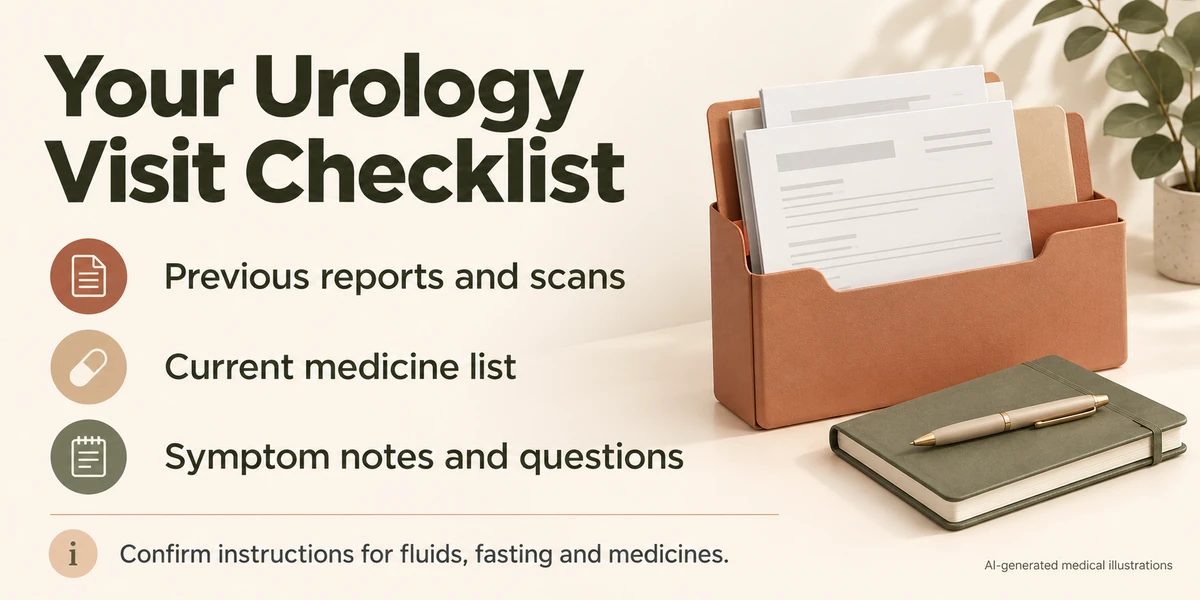
Preparing for a urology consultation can make it easier to explain your concerns and discuss the next steps. Useful items include previous reports, relevant scans, a current medicine list and a short summary of symptoms.
Follow the instructions for your particular appointment. A consultation, urine-flow test, scan and procedure may require different preparation. Do not assume that everyone needs to fast, arrive with a full bladder or stop medicines.
Bring available records relevant to the reason for your visit. Arrange them by date, with recent results easy to find.
| Record | What to bring |
|---|---|
| Laboratory reports | Relevant blood tests, urinalysis and urine-culture results. |
| Imaging | Ultrasound, CT, MRI or X-ray reports and available images. |
| Referral letters | Information explaining the reason for specialist assessment. |
| Previous treatment records | Discharge summaries and relevant operation notes. |
| Pathology reports | Results from previous biopsies or removed tissue, when relevant. |
| Device information | Available details of a urinary catheter or ureteric stent. |
Bring what you already have rather than arranging new tests independently. The need for updated investigations depends on the clinical question and previous findings.
Include prescription medicines, non-prescription products, vitamins, herbal remedies and supplements. Record the name, dose and how often each is taken.
Mention allergies, previous reactions and recent medicine changes. If names are uncertain, bring the packaging or clear photographs of the labels. A complete list helps the healthcare professional understand your treatment and potential contributing factors.
Do not stop prescribed medicines simply because a urology appointment is approaching. If a procedure is planned, ask for specific instructions about medicines, including blood thinners and diabetes treatment. Preparation can vary with the procedure and anaesthetic plan.
A few clear notes can help you remember important details.
Consider recording:
Mention relevant medical conditions, previous operations, catheter use and bowel difficulties. These details can influence assessment of urinary symptoms.
For related information, read about common urological problems.
A bladder diary can be useful when the concern involves frequency, urgency, leakage or nighttime urination.
If requested, record the information using the form and duration recommended by the treating team. A diary covering at least three days is commonly used in assessment of urinary incontinence.
| Diary item | What to record |
|---|---|
| Drinks | Time, type and approximate amount. |
| Urination | Time and measured volume, if requested. |
| Urgency | Episodes of a sudden, difficult-to-defer urge. |
| Leakage | When it happens and associated activities or symptoms. |
| Nighttime pattern | Waking to urinate and relevant sleep information. |
The diary helps describe your usual pattern. It is not necessary for every appointment, and completing one should not delay urgent assessment.
Check the appointment letter or contact the service if instructions are unclear.
| Question | Why to clarify it |
|---|---|
| Is this a consultation or a procedure appointment? | Preparation may differ. |
| Is a comfortably full bladder needed? | Some investigations require it; others do not. |
| Should a urine sample be provided? | Collection and timing instructions may apply. |
| Is fasting necessary? | Requirements depend on the planned test or anaesthetic. |
| Are medicine changes required? | Any adjustment needs clear, individual instructions. |
| Will someone need to accompany me home? | This may be required after sedation or anaesthesia. |
For procedures such as cystoscopy or ureteroscopy, instructions may include urine testing, medicine advice, fasting or transport arrangements. These requirements should be confirmed beforehand. NIDDK
Do not force large amounts of water or hold urine until painful because you assume a full bladder is required. Ask for instructions suited to the appointment and any existing fluid restriction.
Prioritise the concerns that matter most to you. Useful questions include:
These are discussion prompts, not a list that every consultation must cover. Leave space to note the answers and any decisions.
The consultation usually begins with a discussion of symptoms, medical history, medicines and previous results. A focused examination may be appropriate.
For urinary-emptying concerns, assessment may include a post-void residual measurement to check how much urine remains after urination. Other tests are selected according to the suspected cause.
| Possible investigation | What it may help assess |
|---|---|
| Urine testing | Infection or other urinary abnormalities. |
| Blood tests | Kidney function and relevant abnormalities. |
| Urine-flow testing | The speed and pattern of urination. |
| Post-void residual measurement | Urine remaining after urination. |
| Selected imaging | Structural findings, stones or possible obstruction. |
| Selected cystoscopy | The inside of the urethra and bladder. |
Not everyone needs every investigation. A first consultation does not automatically mean surgery or an invasive test. NIDDK
Read more about assessment of incomplete bladder emptying.
If helpful, bring a trusted person to support the discussion and take notes. You can also ask to speak privately for part of the appointment.
Request an interpreter or communication support in advance when needed. Bring glasses, hearing aids or other aids that help you understand the conversation. Ask for unfamiliar terms or instructions to be explained clearly. National Institute on Aging
For an intimate examination, ask what it involves, why it is recommended and whether a chaperone is available.
Sudden inability to pass urine requires emergency medical assessment. Do not wait for a scheduled consultation or spend time gathering paperwork first. NIDDK
Severe pain, fever with urinary symptoms or rapid deterioration may also need urgent assessment. Keep the appointment team informed if your condition changes before the planned visit. NIDDK
For stone-related concerns, read about kidney stone evaluation and investigations.
Bring available reports, relevant scans, a current medicine list, symptom notes and your main questions.
Not automatically. Follow any specific instructions; otherwise, let the assessment determine which investigations are needed.
No. Confirm whether this is required for the particular appointment or test.
Only if instructed. Fasting requirements depend on what is planned.
Not independently. Obtain specific instructions if a test or procedure requires an adjustment.
A trusted person may help with support and recall. You may also request time to speak privately.
Seek emergency medical assessment rather than waiting for the appointment.
A useful preparation checklist includes previous records, a medicine list, symptom notes and questions. Confirm any instructions about fluids, samples, fasting or medicines before attending.
Preparation can support a clearer discussion, but it should never delay urgent care. Before leaving, confirm the next steps, result-review arrangements and follow-up plan.
Disclaimer: Website content and visuals are for general informational, educational and representational purposes only, may not reflect individual patient conditions or outcomes, and do not replace personalised medical advice, diagnosis or clinical assessment.
Plot no 70, Moreshwar Heritage, Sector 5, Ulwe, Navi Mumbai, Maharashtra 410206
For Booking: +91 8591009591
Chat With Us
49, Sion – Panvel Hwy, Sector 7, Vashi, Navi Mumbai, Maharashtra 400703
For Booking: +91 8007542142
Chat With Us