
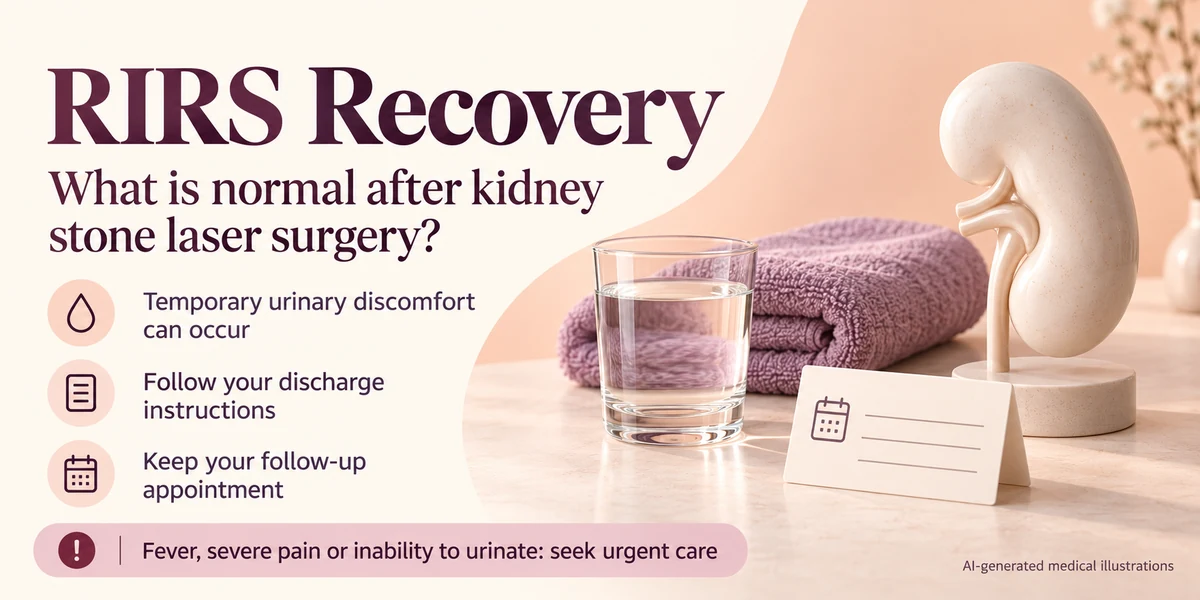
Recovery after retrograde intrarenal surgery, or RIRS, varies between individuals. Mild burning during urination, some blood staining and temporary discomfort can occur after treatment. However, fever, worsening pain, heavy bleeding or difficulty passing urine need medical assessment.
Knowing what to expect can help you follow the discharge plan and recognise when additional care is needed. This guide explains common recovery concerns without assuming that everyone follows the same timeline.
RIRS uses a flexible telescope passed through the urethra, bladder and ureter to reach stones inside the kidney. Laser energy breaks the stones into smaller pieces, which may be extracted or left as fine fragments to pass.
A temporary ureteric stent or bladder catheter may be used, depending on the procedure and clinical findings.
Read more about RIRS laser treatment for kidney stones.
The healthcare team monitors recovery from anaesthesia, discomfort and the ability to pass urine. Many patients leave hospital the same day or the following morning, while others need longer observation.
Arrange the support recommended by the hospital. An adult should usually remain with you during the first 24 hours after discharge following anaesthesia.
Before leaving, confirm which medicines to take, whether a stent is present and who to contact if problems develop.
Some urinary symptoms can follow instrumentation or result from a temporary stent.
| Possible symptom | What you may notice |
|---|---|
| Burning during urination | Temporary stinging or irritation when passing urine. |
| Blood-stained urine | A small amount of blood mixed with urine. |
| Bladder discomfort | Soreness or pressure around the lower abdomen. |
| Side discomfort | Aching around the kidney area. |
| Frequency or urgency | Needing to urinate more often or more suddenly. |
These symptoms should be considered alongside their severity and the overall recovery pattern. Mild symptoms do not mean that every subsequent change can safely be ignored.
There is no single date when everyone should feel completely recovered. Return to work depends on comfort, progress and the demands of the job. Stent symptoms can also affect daily activities.
Use the following as discussion points rather than fixed deadlines:
| Recovery stage | What to clarify |
|---|---|
| Before discharge | Medicines, support at home and emergency contact details. |
| Early recovery | Expected symptoms and limits on activity. |
| Return to routine | Readiness for work, driving and exercise. |
| Follow-up | Stent removal, imaging and any further treatment. |
Ask for individual instructions if your work involves lifting, prolonged driving or strenuous physical activity.
A ureteric stent supports drainage between the kidney and bladder. It may cause urgency, frequency, blood staining or discomfort in the bladder, side or groin. Symptoms can become more noticeable after activity or urination.
Some people tolerate a stent with little difficulty; others need review because symptoms interfere with daily life. Do not assume that fever is an expected stent symptom.
Read more about whether a stent is needed after RIRS.
Stents should be removed or changed according to the agreed plan. Keeping one in longer than intended can lead to mineral deposits and more difficult removal.
Keep the planned date readily available. If arrangements are unclear or delayed, contact the treating team. Avoid accidentally pulling an external removal string.
Follow the prescribed pain-relief plan and ask before adding other medicines. Discharge instructions should explain how to use any prescribed treatment and when to request reassessment.
Pain that is severe, increasing or inadequately controlled should not simply be endured at home. Urinary burning accompanied by fever or feeling unwell also needs prompt advice.
Keep a current medicine list with your discharge summary, particularly if another healthcare professional needs to assess you.
Ask for a fluid plan appropriate to your health. Drinking sufficient fluid is important in stone prevention, but the amount should be discussed individually, particularly when kidney failure or another condition affects fluid advice.
There is no need to interpret general advice as a requirement to force large quantities of water.
Follow the discharge instructions for rest, driving and physical activity. Published recovery advice differs, so a general online timeline should not replace the instructions provided for your procedure.
Return to activity gradually. A stent may make strenuous activity uncomfortable or increase blood staining. If symptoms are disruptive, discuss adjustments and whether review is needed.
Long-term dietary advice should reflect the stone type and relevant investigations. There is no universal requirement to avoid milk, all vegetables or every calcium-containing food.
Depending on the findings, advice may address sodium, animal protein, calcium or oxalate. Appropriate dietary calcium remains important for many people with calcium oxalate stones.
For more information, read the kidney stone diet guide.
Seek urgent medical assessment for:
Sudden inability to urinate requires emergency care. Do not wait for a routine follow-up appointment when these symptoms develop.
Feeling better does not establish that every fragment has cleared. Follow-up imaging may identify remaining stones and guide observation or additional treatment.
The type and timing of imaging depend on the stone characteristics, symptoms and treatment findings. Ultrasound or an X-ray may be appropriate; CT is selected when additional detail is needed.
At review, ask:
RIRS recovery can involve temporary urinary discomfort and stent-related symptoms. Follow the discharge plan, confirm stent removal arrangements and attend the recommended review. Fever, severe pain, heavy bleeding or inability to urinate require prompt assessment.
Disclaimer: Website content and visuals are for general informational, educational and representational purposes only, may not reflect individual patient conditions or outcomes, and do not replace personalised medical advice, diagnosis or clinical assessment.
Plot no 70, Moreshwar Heritage, Sector 5, Ulwe, Navi Mumbai, Maharashtra 410206
For Booking: +91 8591009591
Chat With Us
49, Sion – Panvel Hwy, Sector 7, Vashi, Navi Mumbai, Maharashtra 400703
For Booking: +91 8007542142
Chat With Us