
When benign prostatic hyperplasia (BPH) causes a prostate that’s larger than average, many men wonder which surgical option offers lasting relief with minimal downtime. Holmium Laser Enucleation of the Prostate (HoLEP) has emerged as a leading solution, especially for men with sizable glands. This article explains why HoLEP is often recommended for large prostates, who is an ideal candidate, and what patients can expect before, during, and after the procedure.
HoLEP stands for Holmium Laser Enucleation of the Prostate. Using a high‑powered holmium laser delivered through a thin endoscope, the surgeon precisely separates the obstructive prostate tissue from the surrounding capsule and then removes it in small fragments. The technique requires no external incisions and is performed under general anesthesia.
Traditional transurethral resection of the prostate (TURP) works well for glands up to about 80 cc, but larger prostates can increase operative time, bleeding risk, and the chance of incomplete tissue removal. HoLEP’s laser‑based approach allows surgeons to address glands well beyond 100 cc, making it a preferred option for men whose prostates are considered “large” or “very large.”
Multiple clinical studies confirm that HoLEP is safe and effective even when the prostate exceeds 150 cc. According to a 2018 NIH review, HoLEP is “widely regarded as a suitable procedure for extremely large prostate” and offers clear visualization of the capsule, which improves efficiency. The UW Health guide notes that HoLEP is ideal for men with “both bothersome urinary symptoms” and a large gland UW Health. Wellstar’s minimally invasive care article also highlights that HoLEP works well when other minimally invasive options are unsuitable for larger prostates Wellstar. Emory Healthcare reports the lowest retreatment rate of any BPH therapy, reinforcing its durability for all prostate sizes Emory.
While HoLEP can treat any prostate size, certain factors make the procedure especially advantageous:
Men who meet these criteria should discuss HoLEP with a urologist experienced in laser enucleation. For a broader view of BPH symptoms, see our article on nighttime urination after 50.
HoLEP offers several distinct advantages over traditional and newer BPH procedures:
Like any surgery, HoLEP carries potential risks, though they are generally low:
Recovery typically involves a brief catheter stay (12–24 hours) and a gradual return to normal activities over 2–3 weeks. Patients are advised to avoid heavy lifting and vigorous exercise until cleared by their surgeon.
Preparation steps include:
During the procedure, the surgeon inserts a resectoscope with the laser fiber through the urethra. The laser enucleates the obstructive tissue, which is then morcellated (cut into small pieces) and removed. Because there are no external incisions, postoperative pain is minimal.
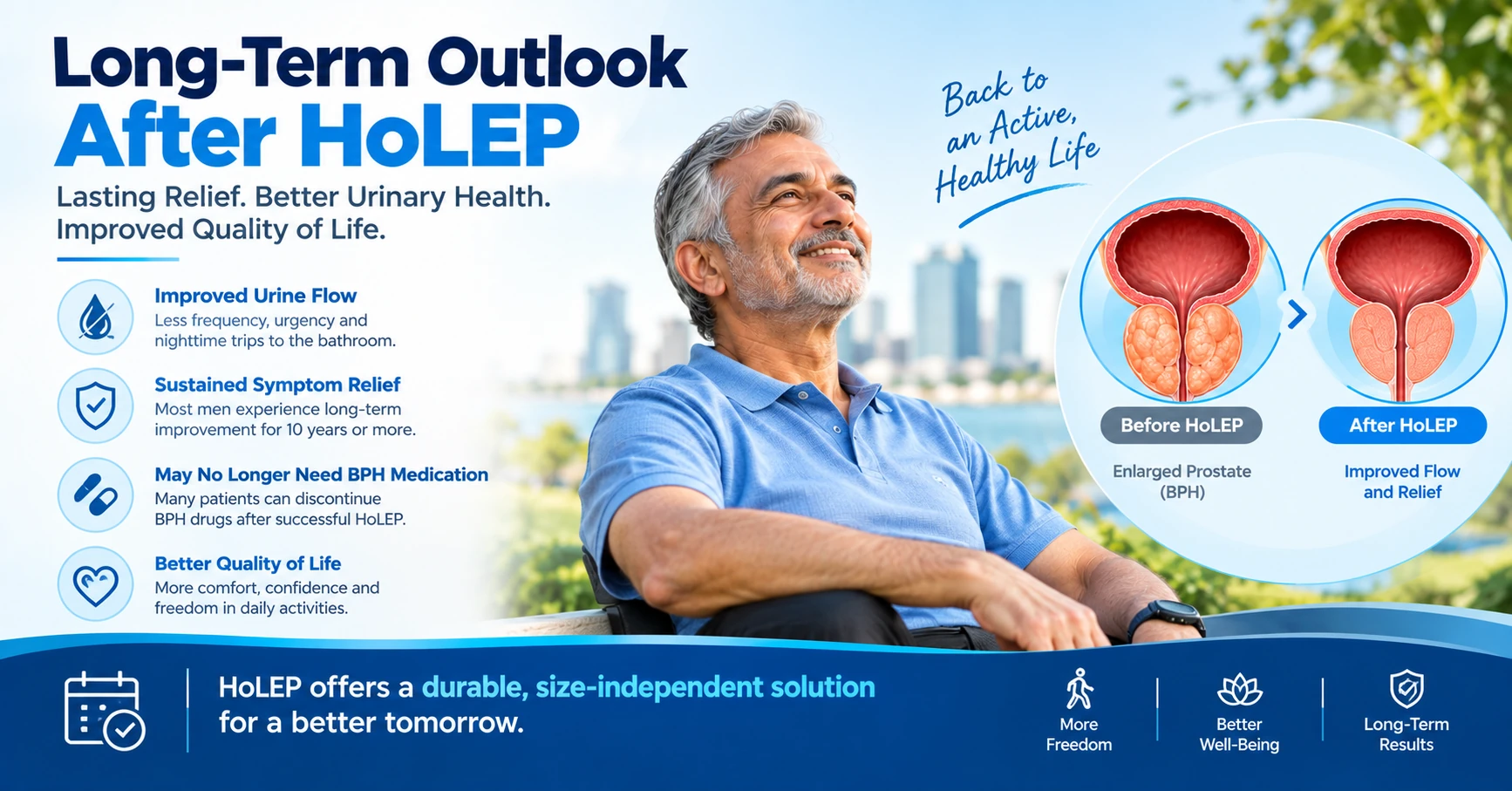
Patients often experience a dramatic reduction in urinary frequency, urgency, and nighttime trips to the bathroom. Follow‑up appointments focus on confirming that urine flow has normalized and that any lingering irritation has subsided. Most men report sustained symptom relief for 10 years or more, making HoLEP a cost‑effective choice over the long run.
For a deeper dive into BPH treatment options, explore our common urology problems guide.

Like any surgery, HoLEP carries potential risks, though they are generally low:
Recovery typically involves a brief catheter stay (12–24 hours) and a gradual return to normal activities over 2–3 weeks. Patients are advised to avoid heavy lifting and vigorous exercise until cleared by their surgeon.
Preparation steps include:
During the procedure, the surgeon inserts a resectoscope with the laser fiber through the urethra. The laser enucleates the obstructive tissue, which is then morcellated (cut into small pieces) and removed. Because there are no external incisions, postoperative pain is minimal.
Patients often experience a dramatic reduction in urinary frequency, urgency, and nighttime trips to the bathroom. Follow‑up appointments focus on confirming that urine flow has normalized and that any lingering irritation has subsided. Most men report sustained symptom relief for 10 years or more, making HoLEP a cost‑effective choice over the long run.
For a deeper dive into BPH treatment options, explore our common urology problems guide.
Yes. Clinical evidence shows HoLEP is effective for extremely large prostates, often exceeding 150 cc, with low complication rates.
HoLEP uses a laser to enucleate tissue and works for any prostate size, while TURP removes tissue with a cutting loop and is best for smaller glands.
Most patients go home the same day or after an overnight stay, with a catheter for up to 24 hours and a return to normal activities within 2–3 weeks.
Temporary stress incontinence can occur in a small percentage of patients, but it usually resolves within weeks with pelvic‑floor exercises.
Many men discontinue BPH medications after successful HoLEP, though some may need short‑term alpha‑blockers during recovery.
Operative time varies with prostate size but typically ranges from 60 to 120 minutes, including laser enucleation and tissue morcellation.
HoLEP is a versatile, size‑independent surgery that provides lasting relief for men with large prostates. If you’re struggling with BPH symptoms and have a sizable gland, discuss HoLEP with your urologist to determine if this laser‑based solution aligns with your health goals.
Plot no 70, Moreshwar Heritage, Sector 5, Ulwe, Navi Mumbai, Maharashtra 410206
For Booking: +91 8591009591
Chat With Us
49, Sion – Panvel Hwy, Sector 7, Vashi, Navi Mumbai, Maharashtra 400703
For Booking: +91 8007542142
Chat With Us