+91 8007542142/ +91 8591009591 drprakash13@gmail.com Vashi : 11:00AM TO 02:00PM | Ulwe : 06:00PM TO 09:00PM
Do You Always Need a Stent After RIRS? What Patients Should Know
Retrograde Intrarenal Surgery (RIRS) has become a go‑to option for treating kidney stones, but many patients wonder whether a ureteral stent is inevitable after the procedure. This article breaks down the science, the latest guidelines, and practical tips so you can make an informed decision about post‑operative care.
What Is a Stent After RIRS?
After RIRS, doctors often place a small, soft tube called a ureteral stent between the kidney and the bladder. The device is roughly 20–30 cm long—about the length of a piece of spaghetti—and as thin as a hair. One end curls inside the kidney, the other curls inside the bladder to keep the stent from migrating. Its primary job is to keep the urinary tract open, allowing urine to flow freely while the ureter heals. Learn more about the design and purpose of the stent after RIRS.
How Does the Stent Work?
The curled ends act like tiny anchors, preventing the tube from slipping. By propping the ureter open, the stent reduces the risk of swelling, blockage, or injury that could otherwise cause pain or infection. It also creates a pathway for any residual stone fragments to pass naturally.
When Is a Stent Typically Placed?
In many centers, a double‑J (DJ) stent is placed at the end of the procedure and left in place for about two weeks before removal. This practice stems from early experiences where ureteral trauma was common, and the stent served as a safety net. Clinical trial protocol for post‑RIRS stenting outlines the standard two‑week timeline.
Pre‑operative stenting is another strategy used to dilate the ureter before the flexible scope is introduced. By gently expanding the passage, surgeons can more easily insert the access sheath and navigate the kidney. Research on routine pre‑op stenting for RIRS explains why many hospitals still follow this habit.
DJ stent after RIRS showing benefits, possible side effects and warning symptoms
Are Stents Always Necessary?
Recent advances in ultra‑thin flexible scopes and suction‑enabled techniques (such as FANS RIRS) have sparked a debate: is a stent always required? The Cure Stone article on stent‑less RIRS reports that when the stone is small, uncomplicated, and removed without causing ureteral trauma, many urologists now skip the stent entirely.
A 2015 PubMed review concluded that routine double‑J stent insertion after RIRS is not essential and may increase costs, morbidity, and operating time. PubMed analysis of routine stenting after RIRSsupports a more selective approach.
Even in complex cases, the evidence is mixed. A case report describing a “steinstrasse” (stone street) after RIRS for a large staghorn stone highlighted that stents can help prevent ureteral blockage, yet the authors noted that the necessity of routine stenting remains unclear. Case report on steinstrasse after RIRS illustrates this nuance.
Situations Where a Stent May Be Omitted
Stone size is ≤ 10 mm and easily retrieved.
No significant ureteral swelling or trauma during the procedure.
Use of modern suction‑enabled scopes that minimize residual fragments.
Patient has a low risk of postoperative infection or obstruction.
Benefits and Risks of Stenting
Benefits
Prevents ureteral stricture by keeping the passage open during healing.
Facilitates drainage of urine, reducing pressure‑related pain.
Allows any tiny stone fragments to pass without causing blockage.
Potential Risks
Discomfort or urinary urgency often described as “stent‑related pain.”
Most patients experience mild to moderate discomfort for the first few days. Strategies to ease symptoms include staying well‑hydrated, using over‑the‑counter pain relievers such as ibuprofen, and avoiding bladder irritants like caffeine and alcohol. Tips for managing stent discomfort after RIRS offers a detailed checklist.
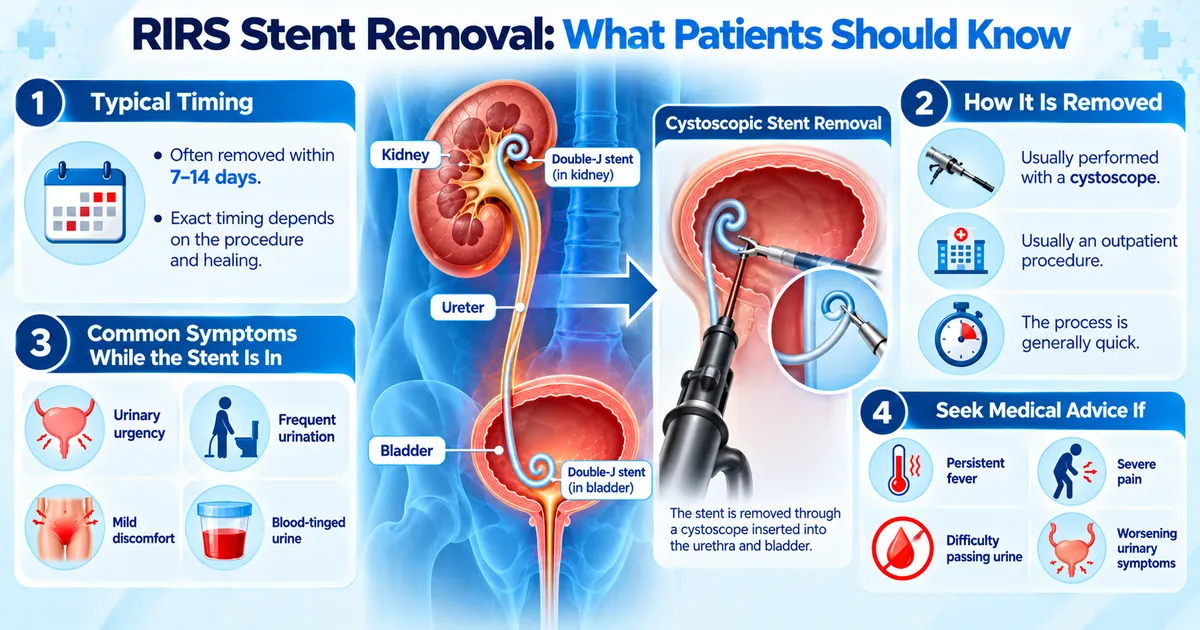
Stent removal is typically performed cystoscopically in the office after 1–2 weeks. The procedure is quick, often painless, and does not require anesthesia. If you notice persistent fever, severe pain, or inability to urinate, contact your urologist immediately.
Stent removal is a quick office procedure using a cystoscope; most patients experience little to no discomfort.
Conclusion
While a stent after RIRS remains common practice, it is not universally required. Discuss your stone size, procedural details, and personal risk factors with your urologist to decide whether a stent is truly necessary for you.