
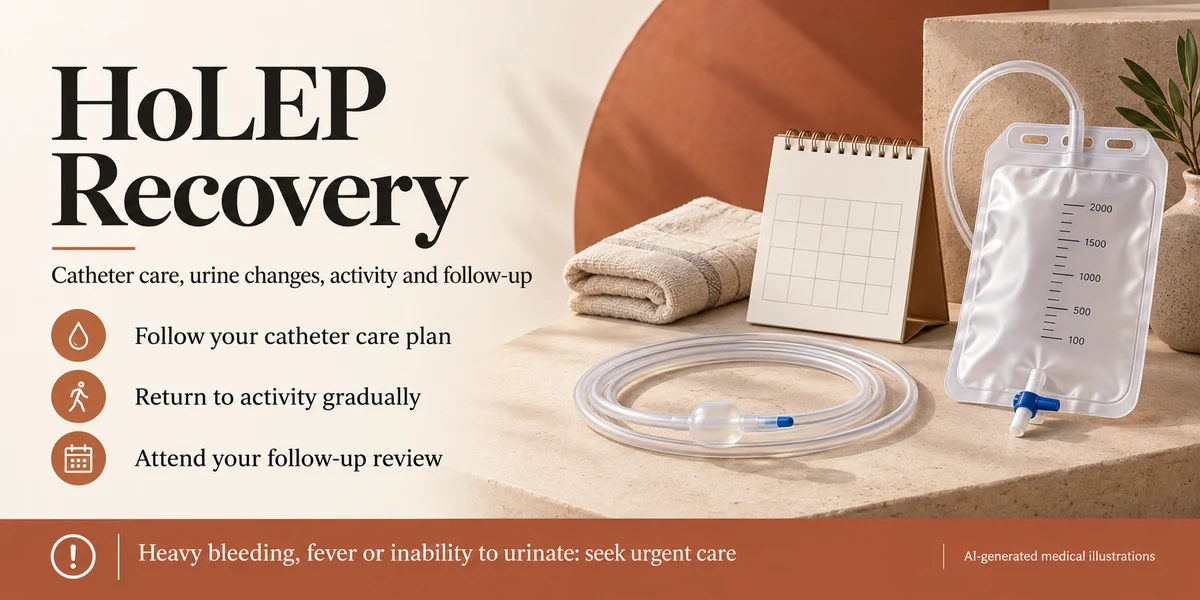
Recovery after holmium laser enucleation of the prostate, or HoLEP, involves more than catheter removal. Temporary burning, blood-stained urine and changes in bladder control can occur while the operated area heals.
Heavy bleeding, large clots, fever or inability to pass urine require prompt assessment. Knowing which changes may occur and when to seek help is an important part of postoperative care.
HoLEP removes obstructing inner prostate tissue using a laser passed through a telescope in the urethra. Its usual purpose is to improve urine drainage affected by benign prostate enlargement.
It does not remove the entire prostate, and it cannot guarantee that every urinary symptom will disappear.
Read more about HoLEP laser prostate surgery.
A temporary catheter drains urine from the bladder. Bladder irrigation may run through it to wash out blood and clots.
The team monitors bleeding, recovery from anaesthesia and readiness for discharge. Some patients go home with a catheter; others remain in hospital until it has been removed. The plan depends on individual findings and the hospital’s care pathway.
Before discharge, obtain written instructions covering medicines, catheter care, removal arrangements and emergency contact details.
There is no universal catheter-removal deadline. Some pathways arrange removal the following morning, while others plan removal several days later.
Removal involves checking whether you can pass urine adequately without the catheter. Occasionally, another catheter is needed temporarily before a further attempt.
Ask who will remove it, where this will happen and what to do if drainage stops before the appointment.
Follow the practical demonstration provided by the nursing team.
| Area | Practical approach |
|---|---|
| Hand hygiene | Wash hands before and after handling the equipment. |
| Daily cleaning | Gently clean the catheter-entry area with mild soap and water. |
| Drainage tubing | Avoid kinks or bends that could interrupt drainage. |
| Collection bag | Keep it below bladder level and empty it before it becomes full. |
| Equipment changes | Follow the instructions provided for your particular system. |
A blocked catheter, significant leakage around it, severe bladder spasms or a catheter that falls out needs prompt advice.
After catheter removal, urination may initially feel uncomfortable. Blood staining, urgency and frequency can also occur.
| Possible change | What you may notice |
|---|---|
| Blood-stained urine | Intermittent pink or red staining during healing. |
| Burning | Stinging or discomfort when passing urine. |
| Frequency | Needing to urinate more often. |
| Urgency | A sudden need to reach the toilet. |
| Leakage | Reduced control, sometimes requiring pads. |
Some blood staining can recur over several weeks. However, the amount, associated symptoms and overall pattern matter: heavy bleeding or difficulty passing urine should not be dismissed as routine healing.
Not always. Flow may improve before urgency, nighttime urination or leakage settles. Some symptoms arise from bladder function as well as prostate obstruction.
Temporary leakage often improves, but persistent or troublesome symptoms need review. Ask for instruction on pelvic floor exercises and when to start or resume them.
For background information, read about prostate conditions and urinary symptoms.
Recovery generally progresses over several weeks, although comfort, stamina and bladder symptoms may improve at different rates.
Avoid treating an online timeline as clearance for strenuous activity. Return to work depends on symptoms, the demands of the job and the treating team’s advice.
Useful milestones to discuss include:
Rest initially and increase activity gradually. Heavy lifting, strenuous exercise and cycling usually need a temporary pause. The duration should follow your discharge instructions.
Driving requires recovery from anaesthesia and the ability to control the vehicle and perform an emergency stop safely. Feeling comfortable while sitting is not the only consideration.
Ask for specific guidance if your work involves physical labour, long journeys or machinery.
Ask for a fluid plan suitable for your health. Some postoperative guidance recommends additional fluids, but this must be reconciled with any existing medical restriction. Avoid constipation through suitable fluids and fibre.
Request a written medicine plan covering pain relief, any prescribed antibiotics and whether previous prostate medicines should continue. If blood-thinning treatment was interrupted, confirm the restart instructions before leaving hospital. Do not make independent changes based on general online advice.
Dry or retrograde ejaculation is common after standard HoLEP. Semen passes backwards into the bladder rather than out through the penis during ejaculation, which can affect fertility.
This differs from erection difficulties. Discuss reproductive plans and any sexual concerns with the treating team. Resume sexual activity according to the postoperative advice and your comfort.
Seek urgent medical assessment for:
If a catheter stops draining and the bladder feels full or painful, seek urgent help. Do not attempt to flush or remove it unless specifically trained and instructed.
Follow-up assesses treatment response, bladder emptying and complications. The timing varies; confirm the appointment rather than assuming a fixed schedule.
| Review area | What may be assessed |
|---|---|
| Symptom review | Flow, urgency, frequency and effects on daily life. |
| Urine-flow testing | The speed and pattern of urination. |
| Post-void residual measurement | Urine remaining after urination. |
| Continence review | Leakage and the need for further support. |
| Sexual function | Changes in erections or ejaculation. |
These assessments help guide further care.
Removed prostate tissue is examined in a laboratory. Ask how and when the result will be communicated, including whether any unexpected finding requires further assessment.
Read more about HoLEP for a large prostate.
Some blood staining can recur over several weeks. However, the amount, associated symptoms and overall pattern matter: heavy bleeding or difficulty passing urine should not be dismissed as routine healing. Will Urinary Control Improve Immediately?
Not always. Flow may improve before urgency, nighttime urination or leakage settles. Some symptoms arise from bladder function as well as prostate obstruction.
Temporary leakage often improves, but persistent or troublesome symptoms need review. Ask for instruction on pelvic floor exercises and when to start or resume them.
For background information, read about prostate conditions and urinary symptoms.
Recovery generally progresses over several weeks, although comfort, stamina and bladder symptoms may improve at different rates.
Avoid treating an online timeline as clearance for strenuous activity. Return to work depends on symptoms, the demands of the job and the treating team’s advice.
Useful milestones to discuss include:
Rest initially and increase activity gradually. Heavy lifting, strenuous exercise and cycling usually need a temporary pause. The duration should follow your discharge instructions.
Driving requires recovery from anaesthesia and the ability to control the vehicle and perform an emergency stop safely. Feeling comfortable while sitting is not the only consideration.
Ask for specific guidance if your work involves physical labour, long journeys or machinery.
Ask for a fluid plan suitable for your health. Some postoperative guidance recommends additional fluids, but this must be reconciled with any existing medical restriction. Avoid constipation through suitable fluids and fibre.
Request a written medicine plan covering pain relief, any prescribed antibiotics and whether previous prostate medicines should continue. If blood-thinning treatment was interrupted, confirm the restart instructions before leaving hospital. Do not make independent changes based on general online advice.
Dry or retrograde ejaculation is common after standard HoLEP. Semen passes backwards into the bladder rather than out through the penis during ejaculation, which can affect fertility.
This differs from erection difficulties. Discuss reproductive plans and any sexual concerns with the treating team. Resume sexual activity according to the postoperative advice and your comfort.
Seek urgent medical assessment for:
If a catheter stops draining and the bladder feels full or painful, seek urgent help. Do not attempt to flush or remove it unless specifically trained and instructed.
No. Removal timing depends on recovery, findings and the planned care pathway.
Yes. Intermittent staining can occur during healing. Heavy bleeding or large clots need urgent assessment.
No. Temporary leakage can occur, but persistent or troublesome leakage needs review.
Not necessarily. Bladder and other contributing factors may remain after obstruction is treated.
Yes. Some patients temporarily need another catheter before a further removal attempt.
No. Ejaculation and erection are different functions, although either concern can be discussed during review.
Yes. Review also considers bladder emptying, adverse effects and remaining symptoms.
HoLEP recovery involves healing, catheter management and gradual adjustment in urinary symptoms. Follow the individual discharge plan and attend review. Heavy bleeding, fever, severe pain or inability to pass urine require prompt assessment.
Disclaimer: Website content and visuals are for general informational, educational and representational purposes only, may not reflect individual patient conditions or outcomes, and do not replace personalised medical advice, diagnosis or clinical assessment.
Plot no 70, Moreshwar Heritage, Sector 5, Ulwe, Navi Mumbai, Maharashtra 410206
For Booking: +91 8591009591
Chat With Us
49, Sion – Panvel Hwy, Sector 7, Vashi, Navi Mumbai, Maharashtra 400703
For Booking: +91 8007542142
Chat With Us