
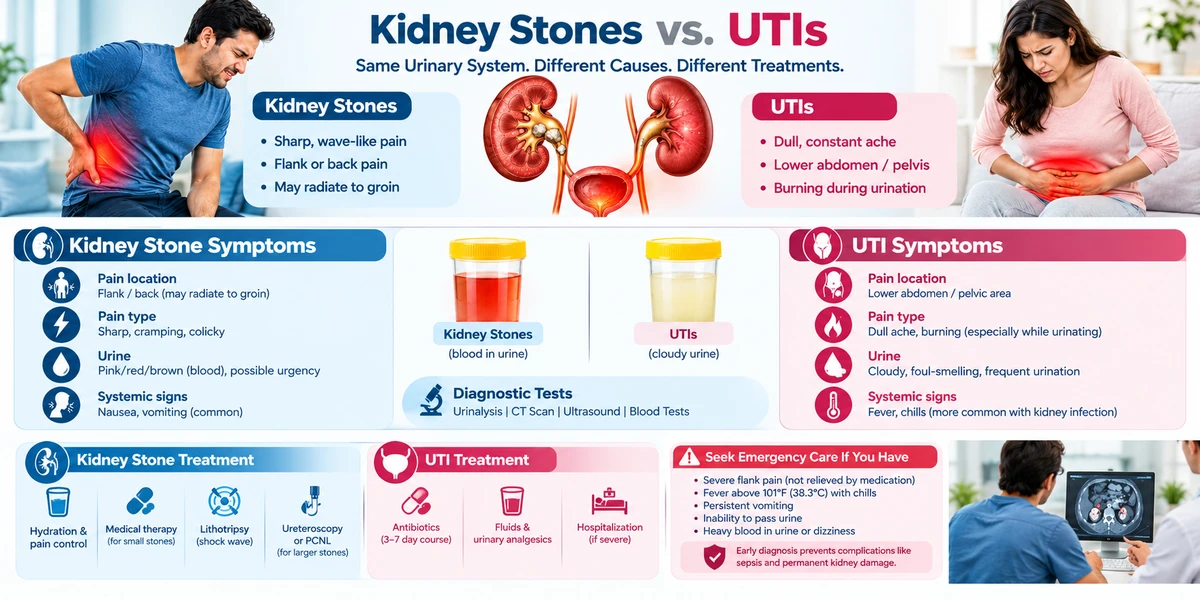
Kidney stones and urinary tract infections (UTIs) affect the same organ system, but they arise from completely different causes. Knowing the subtle clues in your body can help you decide whether you need a stone‑focused treatment plan or an antibiotic regimen.
Both conditions can cause discomfort, urgency, and changes in urine appearance. Below is a side‑by‑side snapshot that highlights the most reliable differentiators.
| Feature | Kidney Stone | UTI |
|---|---|---|
| Pain location | Flank or back, may radiate to groin | Lower abdomen or pelvic area |
| Pain type | Sharp, wave‑like (colicky) | Dull, constant pressure or burning |
| Urination | Frequent urges, painful when stone passes | Burning, urgency, incomplete emptying |
| Urine color | Pink/red or brown (blood) | Cloudy, may have traces of blood |
| Systemic signs | Nausea, vomiting, possible fever | Fever more common with kidney‑level infection |
Kidney stones typically start as a sudden, intense pain in the side (flank) or lower back. The pain often comes in waves as the stone moves, and it can radiate toward the lower abdomen, groin, or even the inner thigh. This “renal colic” is described as one of the strongest pain sensations, sometimes accompanied by sweating, chills, or a rapid heartbeat.
Lower urinary tract infections (cystitis) produce a more constant, aching discomfort in the suprapubic region. The sensation is usually described as a burning pressure rather than a cramping wave. If the infection spreads to the kidneys (pyelonephritis), the pain may shift to the flank, but it is usually less intermittent than stone pain.
As a stone approaches the bladder or urethra, patients often report a sudden urge to urinate and sharp pain during voiding. The pain may be brief but intense, especially when the stone passes through the urethra.
UTIs are characterized by a burning feeling at the start or end of urination, a persistent urge to go, and the sensation that the bladder never fully empties. Women experience these symptoms more frequently due to a shorter urethra UbieHealth symptom checker.
Both conditions can cause visible changes in urine, but the patterns differ.
Fever is a red flag for both conditions when they involve the upper urinary tract. Kidney stones can trigger nausea and vomiting simply from the intense pain, while a kidney infection (a type of UTI) often presents with fever, chills, and systemic malaise.
According to MyNephrologist, severe flank pain accompanied by fever or vomiting should prompt immediate medical evaluation.
A simple dip‑stick test can detect white blood cells (infection), nitrites (bacterial growth), and blood (hematuria). The presence of both infection markers and blood may indicate a stone with a secondary infection.
Non‑contrast CT scans are the gold standard for identifying stones, while ultrasound can reveal kidney swelling or obstruction. For UTIs, especially uncomplicated bladder infections, imaging is rarely needed unless symptoms are atypical.
For a deeper dive into imaging choices, see the Kidney stone evaluation guide.
Small stones (<5 mm) often pass with increased fluid intake, pain control (NSAIDs), and medical expulsive therapy (e.g., tamsulosin). Larger stones may require lithotripsy, ureteroscopy, or percutaneous nephrolithotomy. Hydration and dietary adjustments are essential for prevention.
UTIs are treated with a short course of antibiotics tailored to the likely bacteria. Women with uncomplicated cystitis often receive trimethoprim‑sulfamethoxazole or nitrofurantoin. Men and patients with kidney involvement need longer regimens and sometimes intravenous therapy.
For gender‑specific guidance, refer to our UTI in men overview.
If you experience any of the following, seek medical attention right away:
These warning signs can indicate a blocked urinary tract, a large stone, or a serious kidney infection. Prompt evaluation can prevent complications such as sepsis or permanent kidney damage Advanced Urology recommendations.
While kidney stones and UTIs share some urinary symptoms, the location and character of pain, the presence of burning, and systemic signs like fever help differentiate them. Accurate diagnosis through urinalysis and imaging guides the appropriate treatment—whether it’s hydration and pain control for a stone or antibiotics for an infection.
Kidney stone pain is sharp, wave‑like, and located in the flank or groin, often with blood in the urine. UTI pain is a constant burning in the lower abdomen with frequent, urgent urination and cloudy urine.
Yes, especially if the stone blocks urine flow and leads to a secondary infection. Fever with flank pain should be evaluated promptly.
A bladder infection can cause microscopic blood, but visible pink or red urine is more typical of kidney stones.
A urinalysis checks for infection markers and blood, while a non‑contrast CT scan or ultrasound visualizes stones and any obstruction.
Seek emergency care for severe, unrelenting flank pain, fever with chills, vomiting that prevents hydration, or inability to urinate.
Small stones may pass with plenty of water, pain relievers, and medical expulsive therapy, but larger stones require medical procedures.
Understanding the distinct patterns of kidney stone vs UTI symptoms empowers you to seek the right care quickly. If you notice severe flank pain, blood in urine, or fever, contact a healthcare professional without delay.
Plot no 70, Moreshwar Heritage, Sector 5, Ulwe, Navi Mumbai, Maharashtra 410206
For Booking: +91 8591009591
Chat With Us
49, Sion – Panvel Hwy, Sector 7, Vashi, Navi Mumbai, Maharashtra 400703
For Booking: +91 8007542142
Chat With Us