
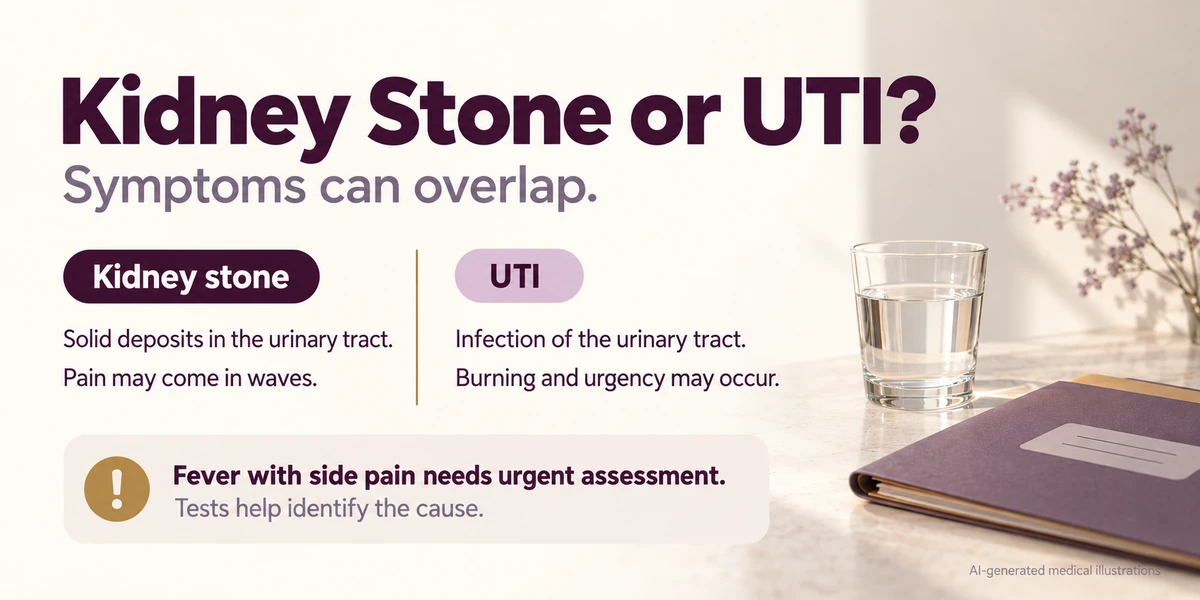
Burning during urination, frequent urges and blood in urine can occur with both kidney stones and urinary tract infections, or UTIs. Although the symptoms may overlap, the underlying causes and treatment differ.
Symptoms alone cannot reliably distinguish a kidney stone from a UTI. Both conditions can also occur together. Assessment helps identify the cause and check whether infection, urinary blockage or another problem requires treatment.
A kidney stone is solid material formed from substances in urine. It may stay within the kidney or move into the ureter—the tube connecting the kidney to the bladder.
Some stones cause no noticeable symptoms. Others cause sharp side or back pain that may spread towards the lower abdomen or groin. Pain can come in waves and may occur with nausea or vomiting.
For related information, read about kidney stone pain and its assessment.
A UTI is an infection affecting part of the urinary tract. A bladder infection, also called cystitis, commonly causes burning, urgency, frequent urination and lower abdominal discomfort.
A kidney infection is a more serious form of UTI. It may cause fever, chills, side or back pain, nausea and vomiting. These symptoms need prompt medical assessment.
These patterns provide clues rather than a diagnosis.
| Feature | Kidney stone | UTI |
|---|---|---|
| Underlying problem | Solid material within the urinary tract. | Infection affecting the urinary tract. |
| Pain location | Often the side or back, sometimes spreading towards the groin. | Bladder infection may cause lower abdominal discomfort; kidney infection may cause side or back pain. |
| Pain pattern | May be severe and occur in waves. | May involve burning or discomfort; the pattern depends on the infection site. |
| Burning or urgency | Can occur. | Common with bladder infection. |
| Blood in urine | Can occur. | Can occur. |
| Nausea or vomiting | May accompany stone-related pain. | May occur with kidney infection. |
| Fever or chills | Raise concern about associated infection. | May indicate kidney infection or more serious illness. |
Pain location, urine appearance or one symptom should not be used alone to decide the cause.
No. Both stones and infection can produce urinary irritation. Other conditions can also cause overlapping symptoms.
Cloudy or strong-smelling urine does not confirm infection by itself. Foods, medicines and insufficient fluid intake may affect urine appearance or smell. Assessment considers accompanying symptoms and relevant test results.
Explain whether symptoms began suddenly, whether pain moves, and whether there is fever, vomiting, visible bleeding or difficulty passing urine.
Yes. A person with a stone may also have an infection.
The particularly urgent situation is infection in an obstructed kidney, where a stone blocks drainage while infection is present. This is a urological emergency.
Treatment may require urgent drainage using a ureteric stent or nephrostomy, together with antibiotics. Definitive stone treatment is generally delayed until the infection has been controlled.
Seek urgent assessment for:
These symptoms should not be managed by waiting to see whether extra water helps.
Confusion, marked drowsiness or difficulty speaking requires emergency care. Suspected UTI symptoms also need prompt professional advice during pregnancy, in men, and in people with diabetes, reduced immunity or a urinary catheter.
Assessment begins with symptoms, medical history and an examination when appropriate. Mention previous stones, infections, antibiotic treatment, urinary procedures, medicines and any possibility of pregnancy.
| Investigation | What it may help assess |
|---|---|
| Urinalysis | Blood, white blood cells and other urinary abnormalities. |
| Urine culture | Bacteria and antibiotic susceptibility when indicated. |
| Blood tests | Kidney function and findings suggesting more serious infection. |
| Ultrasound | Stones, kidney swelling or structural abnormalities. |
| Selected non-contrast CT scan | Stone size, location and possible urinary blockage. |
| Selected further investigations | Possible contributors when symptoms or infections recur. |
Not everyone needs every investigation. A straightforward bladder infection may not require imaging, while suspected stones, obstruction or recurrent infections may justify additional tests.
Read more about kidney stone evaluation and investigations.
No. Urine testing can identify blood, minerals and findings suggesting infection, but it cannot establish every stone’s size or location.
Imaging may be needed to identify stones and assess possible blockage. Test selection depends on the clinical situation.
A urine culture helps identify bacteria and can support antibiotic selection. It is particularly relevant when the clinical situation requires more information about a suspected infection.
Results need interpretation alongside symptoms and other findings. Repeated infections may also prompt investigation for an underlying contributor.
Some stones pass naturally or can be monitored after assessment. Others need a procedure because of persistent pain, blockage or other concerns.
Options may include shock wave lithotripsy, ureteroscopy or percutaneous nephrolithotomy. Treatment selection depends on stone characteristics and individual health. Follow-up may include stone analysis and a prevention plan.
Bacterial bladder infections are commonly treated with antibiotics. The choice and duration depend on factors such as the bacteria, allergies, infection severity and relevant medical conditions.
Take treatment exactly as prescribed. Do not share antibiotics or use leftover medicines for a new episode. Severe kidney infection may require intravenous antibiotics and hospital care.
Read more about urinary tract infections and their assessment.
Antibiotics alone may be insufficient when an infected kidney remains obstructed. Restoring drainage is an important part of emergency management.
This is why fever alongside suspected stone pain requires urgent assessment rather than routine home treatment.
No. Appropriate hydration can support recovery, but it does not replace treatment for infection or urinary obstruction.
Fluid advice should reflect kidney function, other medical conditions and any prescribed restriction. Repeated vomiting may prevent adequate intake and require medical treatment.
Seek reassessment if symptoms worsen or do not begin improving within 48 hours of starting UTI treatment. Do not wait for this interval if urgent warning signs develop.
Repeated infections or recurrent stones may require further investigation. The next step should reflect previous results and treatment rather than automatically repeating the same medicine
Yes. Both can cause burning, frequent urination and blood in urine. Assessment may be needed to distinguish them.
No. Kidney infection and other conditions can cause side or back pain.
Yes. Infection with urinary obstruction is particularly urgent and may require drainage as well as antibiotics.
No. Appearance alone cannot confirm infection. Other symptoms and clinical findings matter.
No. Some pass naturally or can be monitored after assessment.
No. Imaging is selected according to the history, findings and concern about an underlying problem.
Yes. It may indicate infection, including infection associated with urinary blockage.
Kidney stones and UTIs can produce similar symptoms, but they require different treatment discussions. Urine testing and selected imaging help establish the cause and identify complications.
Avoid self-diagnosing from pain or urine appearance alone. Fever with side pain, repeated vomiting or difficulty passing urine needs urgent assessment, particularly when a stone may be blocking drainage.
Disclaimer: Website content and visuals are for general informational, educational and representational purposes only, may not reflect individual patient conditions or outcomes, and do not replace personalised medical advice, diagnosis or clinical assessment.
Plot no 70, Moreshwar Heritage, Sector 5, Ulwe, Navi Mumbai, Maharashtra 410206
For Booking: +91 8591009591
Chat With Us
49, Sion – Panvel Hwy, Sector 7, Vashi, Navi Mumbai, Maharashtra 400703
For Booking: +91 8007542142
Chat With Us